How Does a Vacuum Regulator Work?
Struggling to lock in the exact vacuum depth for your setup? Get insights on choosing the right regulator to maximize workflow efficiency and pump performance.
In today’s world vacuum is not just a tool it is used for accuracy, measurements, management and maintenance;it is extremely important for accuracy. It plays an important role in medical environments like laboratories or many other types of big industries.
The vacuum regulator is like a hero in the whole system of controlling the suction in the suites of surgical and it also manages the manufacturing line pressure.
Table of Contents
ToggleWhat is a Vacuum Regulator?
A vacuum regulator basically maintains the constant level of vacuum in the situation of any change in vacuum like sudden fluctuation or any change in the source or process of vacuum.
Work of Vacuum Regulator
The vacuum regulator works as a standard commonly used regulator but it(vacuum regulator) is somehow different from it(common regulator) in the principles of physics. The vacuum regulator throttles the air pulled into the pump of the vacuum for the surroundings but the pressure regulator which is used commonly pushes the air outside.
Pressure vs Vacuum: A quick Understanding
Vacuum(Negative)
It is always lower than the pressure of the surrounding atmosphere, for example Torr or mbar. This pressure is measured in the inches of mercury |
Pressure (Positive)
It mostly higher than the pressure of atmosphere for example the pressure of car tire |
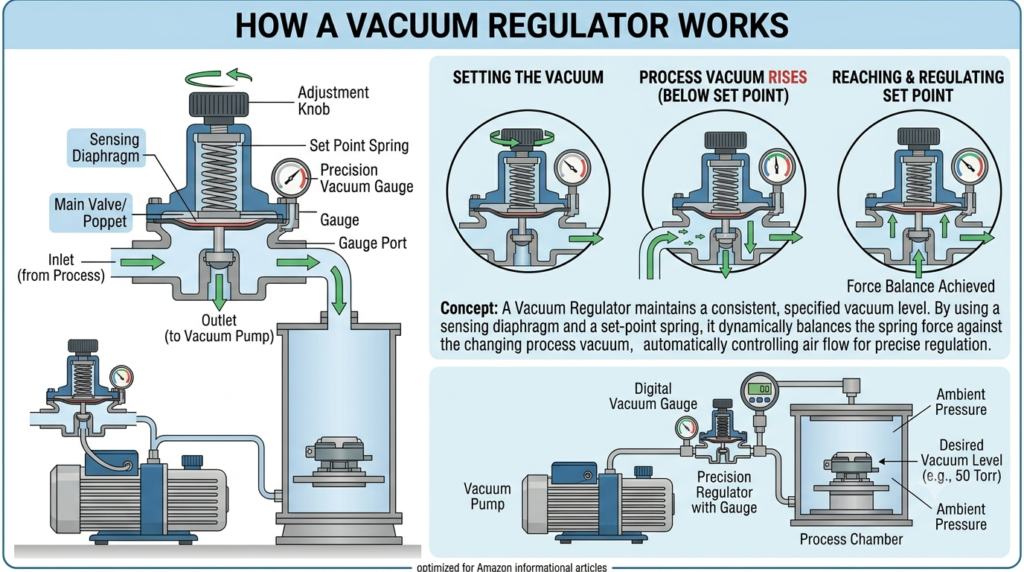
The basic understanding is in the internal balance in vacuum regulators. Many regulators can sense the pressure because of their flexible membrane. We called it Diaphragm-operated system
First step is The Setpoint Mechanism
You have to turn the top knob of the regulator this will compresses a range spring then this springs will apply downward force on internal diaphragm which can show result how much a vacuum is desired
The second step is sense of vacuum
The vacuum sense which is basically bottom of the diaphragm will expose the system of vacuum. The air pull out with the vacuum pump and the diaphragm pressure will drop with this under pressure
The third and most important part is The Act of Balancing
The regulator continuously tries to balance the pressure .The atmospheric pressure which is above the diaphragm pushes it down if the vacuum gets too deep/strongIt will open a valve which will help for a controlled amount of air into the system. This will bleeds the desired vacuum level back
The other side of this process is if the vacuum gets too weak then the spring pushes the diaphragm back it will close the passage of atmosphere and it will allow the pump to pull harder the system
Components of Regulator
Function
Material
The Diaphragm
The element of sensing
Chemical resistance e.g. Viton and Nitrile are used in it
The Valve Seat
The seal which is used for opening and close for regulator air
It is used to prevent creep. It mostly used as precision-machined
The Gauge Port
The vacuum gauge is attached to it
It is very important for the health of system monitoring
The Adjustment Knob
It is important to create the tension of spring
It should be lockable and ergonomic in the settings of industries.
Different Vacuum Regulator Types
In different vacuums regulators work differently. It is not created equally in different industries because of its different uses and needs.
Mechanical Diaphragm Regulators
These are the workhorses which do not require any electricity. They are mechanical purely. They are used where the sparks is not important mostly for hazardous environments
Electric Vacuum Regulators
These are used to maintain pressure with the help of an electronic sensor and a solenoid valve. Mostly high tech computers are used to change the vacuum level instantly. This is specifically a high-tech automation system.
Medical Regulators for suction
These are specifically used in medical fields e.g. hospitals which usually include a Safety trap for suction and protect vacuum lines from fluid which can destroy the vacuum lines. These are specially designed for making sterilization easy.
Now the important point to understand is Why Precision Matters(Industry Applications)
Medical(Healthcare)
Vacuum Regulators are very important to manage the suction in the medical field also. In the operating room the regulators are used to manage the suction for clearance of surgical sites. Vacuum is not so much strong it will not clear properly and if the vacuum is so much strong it can destroy human tissues which is more dangerous
Packing of Food
Vacuum is used in packing industries very much. Vacuum sealers used regulators to give enough air in packets to remove the preserved food crushed inside like perfect delicious potato chips.
Research Laboratory
Vacuum regulators are also used in laboratories for research. In the rotary evaporators a vacuum regulator helps chemists or researchers to lower the boiling point of a solvent.
Final Verdict
The suction system’s brain is a vacuum regulator. It can help you to balance and adequate atmospheric pressure. It also makes sure to balance the pump capacity. Your vacuum regulator is a helping hand for your equipment running properly and safely.
FAQ
Q: What is the difference between a vacuum regulator and a vacuum breaker?
Describe the difference between a vacuum breaker and Vacuum regulator?
A vacuum breaker just works when the vacuum is in much deeper danger then the safety valve will be open only. On the other hand, the vacuum regulator will maintain a specific level for the process. It’s a fidelity tool
Q:Can we reduce the speed of the pump with the help of a regulator?
A regulator plays a very helping part to control and adjust vacuum in our specific setpoint which is very important for a specific speed. Regulators introduce a small amount of air for balance and accuracy of pump’s speed which directly affect it.
Q: Is Whistling of regulators normal and why did this happen?
Yes it’s completely normal and it occurs when usually it moves the air through the port of the atmosphere with a high velocity. It can be caused by slight misalignment of the seal which is inside or it can be caused by the high flow,it’s actually a sign of it.